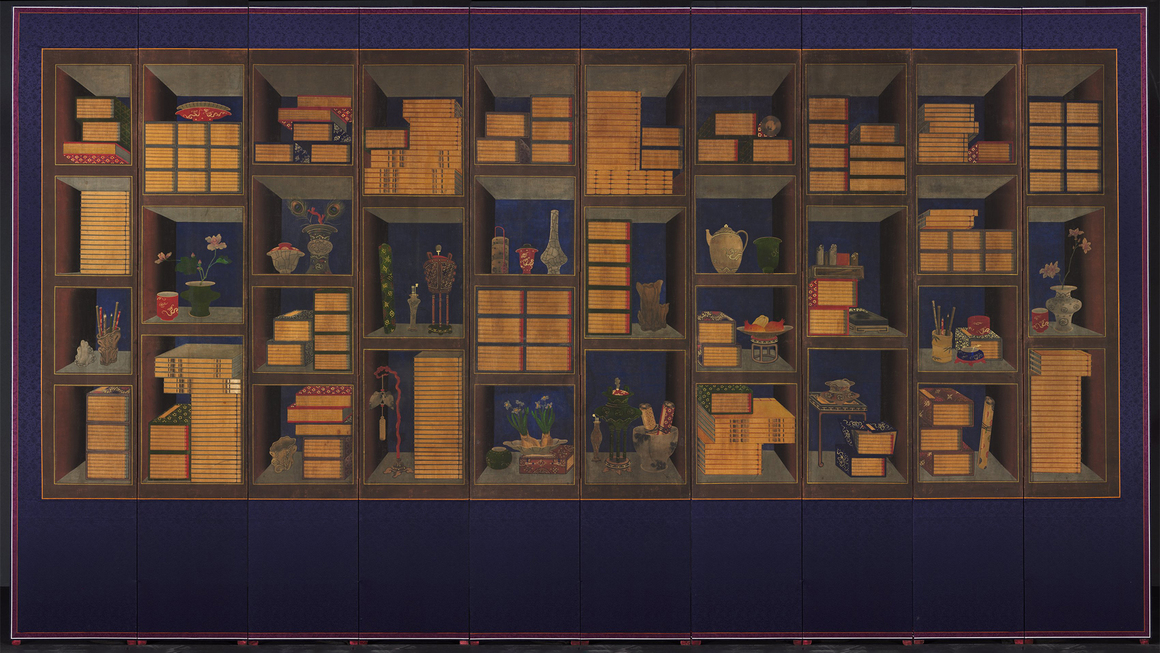
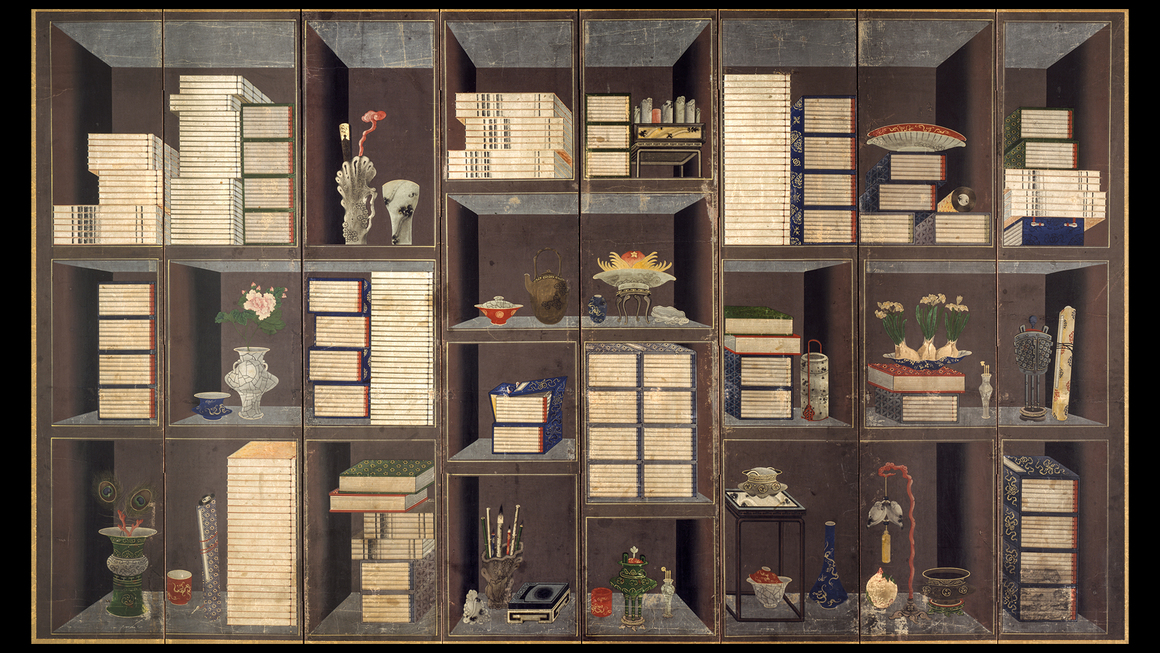
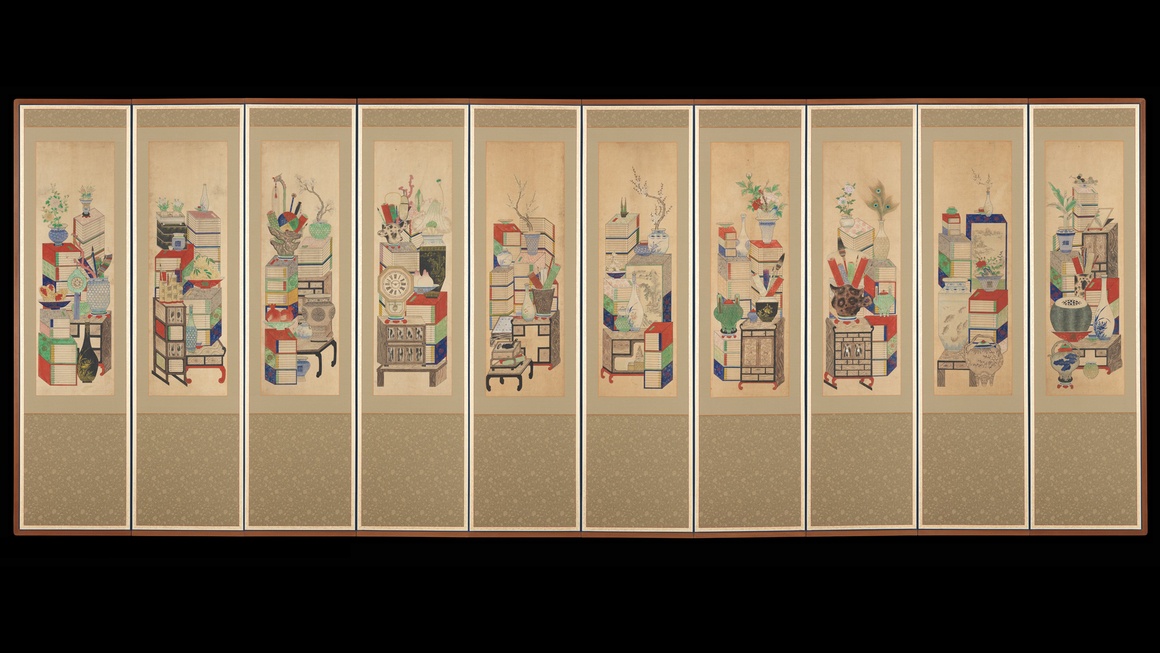
To catch sight of a chaekgeori is to experience a collapse of time and space common to our era of high-speed internet and 787 Dreamliners. Yet it bears remembering that such paintings, depicting carefully rendered bookshelves, predate the easy exchange of ideas. A style of still-life painting from the late Joseon dynasty made between roughly 1776 and 1910, chaekgeori can be translated to mean “bookshelf,” from words meaning “book” and “place.” What could be a fairly static image with a quiet subject and limited vista is made dynamic by the shifting ideological, economic, and aesthetic tides of the era. Perhaps the most contemporary element of a chaekgeori is how much interconnection it really contains.
What a contemporary viewer might simply see as an artfully arranged bookshelf, punctuated by attractive keepsakes, contains a wealth of messages, including tributes to the Confucian tenets of scholarship, longevity, and fertility, as well as references to a complex web of international trade. In a chaekgeori, both the subjects and their rendering speak to a period of transition in Korean art and society. Chaekgeori is just one style of a genre of paintings called munbangdo, characterized by compositions of scholarly tools (e.g., books, brushes, ink, paper) either depicted in isolation, stacked, or on bookshelves. Commonly cited as the first patron of chaekgeori, King Jeongjo ruled Korea from 1776 to 1800. Within King Jeongjo’s writings and poetry, held by the National Museum of Korea, is his introduction of chaekgeori to state officials, fooling them with its trompe l’oeil effect. According to curator Sooa McCormick, King Jeongjo recalled a statement of the philosopher Cheng Yi, in which he said “that if one occasionally entered one’s study and touched one’s books, it would please one, even though one was unable to read books regularly. I came to realize the meaning of the saying through this painting.”
One of the style’s most distinctive traits is the linear perspective, which was a new development in Korean art at the time. Scholars largely agree that the shaded and linear perspective that makes trompe l’oeil so convincing was introduced through diplomatic engagement with China and Japan. For much of the Joseon dynasty, rulers stridently limited Korea’s trade and diplomatic activity to interaction with these two countries. Because of this limited trade, new artistic techniques are often ascribed to a surprisingly limited pool of actors, as in the case of Jesuit priests who hoped to gain the favor of China’s Qing emperors. Restricted from traveling or proselytizing, the Jesuits concentrated their efforts on impressing the court with Western scholarship, technology, and art. Some art historians point to a single priest, Giuseppe Castiglione, who trained as a painter in Milan before he traveled in 1715 to China, where he lived as a missionary and imperial court painter and may have introduced a Western Renaissance approach to perspective. Korean diplomats to Qing China could have seen Castiglione’s now renowned portrait of Emperor Qianlon, depicting the emperor surrounded by a collection of precious objects with trompe l’oeil effects.
Indeed, part of what may appear so contemporary about a chaekgeori is the mixture of artistic traditions, an integration familiar to twenty-first-century viewers steeped in an increasingly global culture. Eleanor Soo-ah Hyun of the Metropolitan Museum of Art has noted that the linear perspective, which elegantly centers the minimally rendered books, also shows off Western objects like clocks and watches along with the ornaments included for their Confucian symbolism. Ceramics are frequently included in the compositions, both the prized works of Korean artisans and the imports from Qing China, as expressions of the owner’s connoisseurship. Synthetic pigments, among the novel imports of the period from China and Japan, also contribute to the contemporary look, with tones like Prussian blue—the first synthetic pigment to take the place of azurite-based color.
What is it that feels so modern about a chaekgeori? The trails are harder to trace forward than back. Open an interiors magazine today and you will find the even, minimal shelving units created by Charles and Ray Eames or the unornamented furniture of Donald Judd or the modular shelves of Jean Prouvé or Dieter Rams (and their many imitators) stacked with books and studded with ornamental vessels. Then consider the colors of Dusen Dusen textiles or the covers of contemporary novels with deep, Prussian blues, vibrant reds, and greens. These eclectic forms, textiles, and templates, which undoubtedly draw on myriad references—from Confucian cardinal colors to the saturated tones of the Memphis group—call to mind a chaekgeori, which were, by nature, invested in the display and depiction of a breadth of art and design objects. Are these modern echoes, recalling a chaekgeori? Or the influences that a chaekgeori collected? From chaekgeori and Chinese duobaoge to the European Wunderkammer, throughout history and across cultures, humans have sought to collect and display their learning, their travels and their success. And while it is no longer common to see painted still lifes of studious vignettes in private homes, rare is the house-proud modern citizen who can resist a post on social media to friends and strangers, showing of their latest collection or loveliest vignette of interior decor.
Julia Berick is a writer who lives in New York. She has published with Vogue, The Paris Review, Harper’s Bazaar UK, T: The New York Times Style Magazine, and elsewhere. She writes about craft and culture.
Related Stories