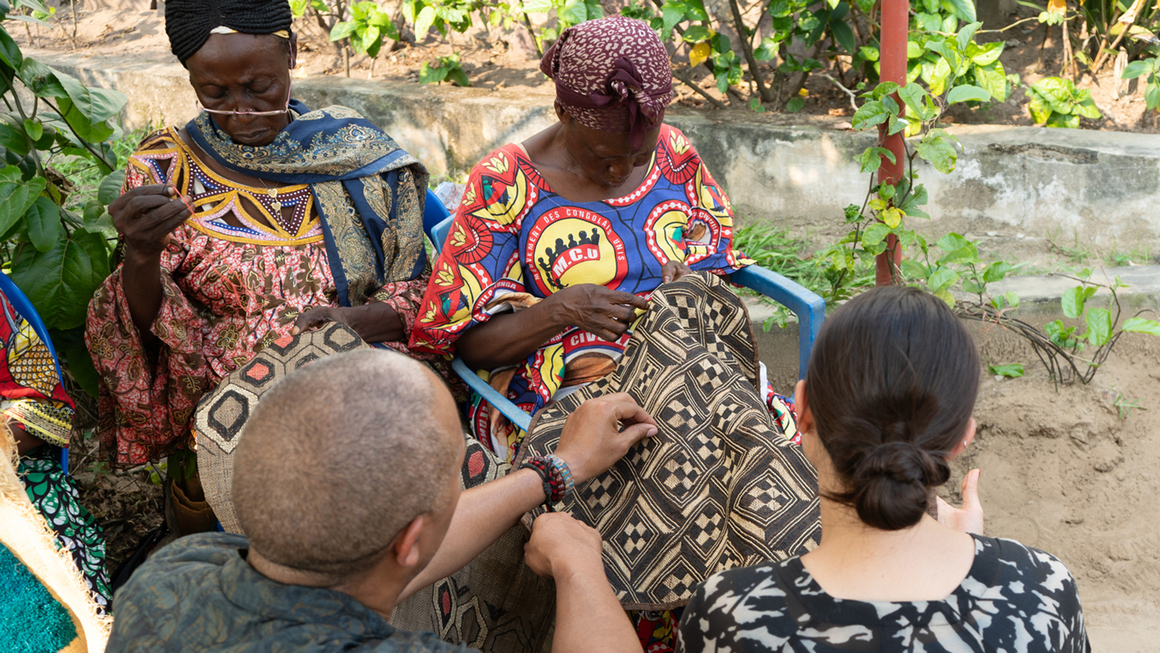
“Kuba is an art form that developed around a royal ideology,” Professor Madubi Woto tells us on a trip to the Democratic Republic of Congo. We’ve come as part of our research into the raffia textiles of the Kuba kingdom, and our host for the week, Jess Kilubukila, brought us to the Academie des Beaux Arts, a lush campus of creativity in central Kinshasa where Professor Woto, a master artisan, explains the history of this renowned art form.
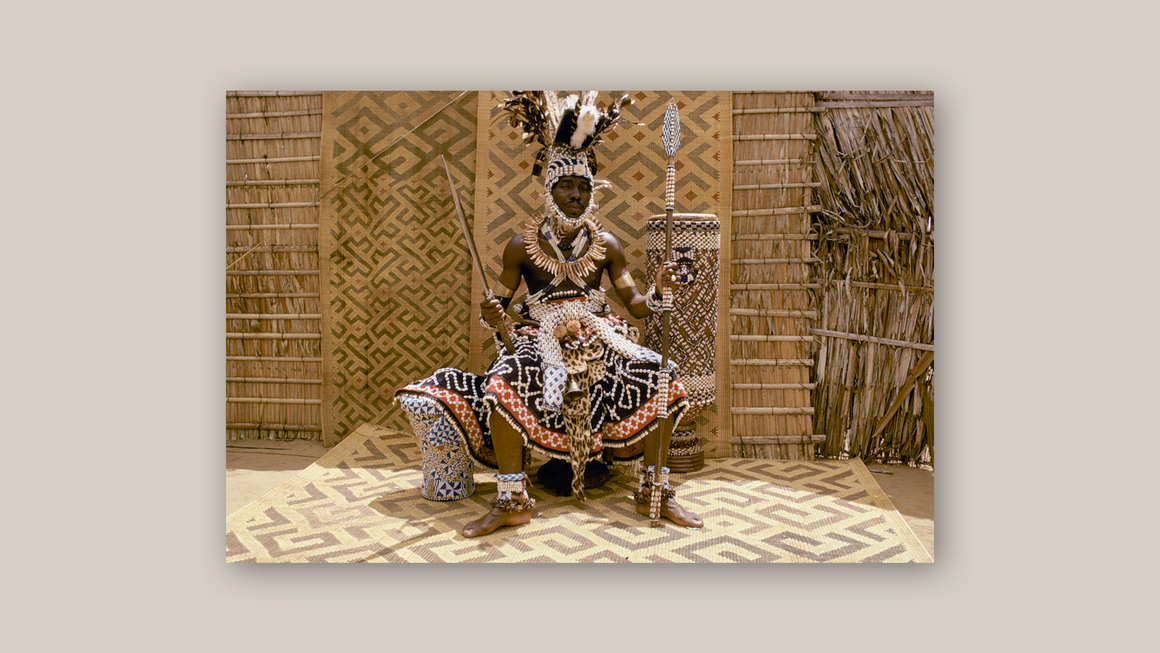
The Kuba people are a confederation of migratory groups who settled in the Kasai region of Central Africa in the 15th and 16th centuries ultimately forming the Kuba kingdom, whose thriving economy was based on the cultivation of the raffia palm. A stunning photograph of the Kuba King Kot a-Mbweeky III from 1970 shows the all-encompassing power of the bold and entrancing language of Kuba art. From his toes, to the crown of his head, the royal figure is covered in raffia, adorned by rhythmic patterning of ornate embroidery, beads, and cowrie shells.
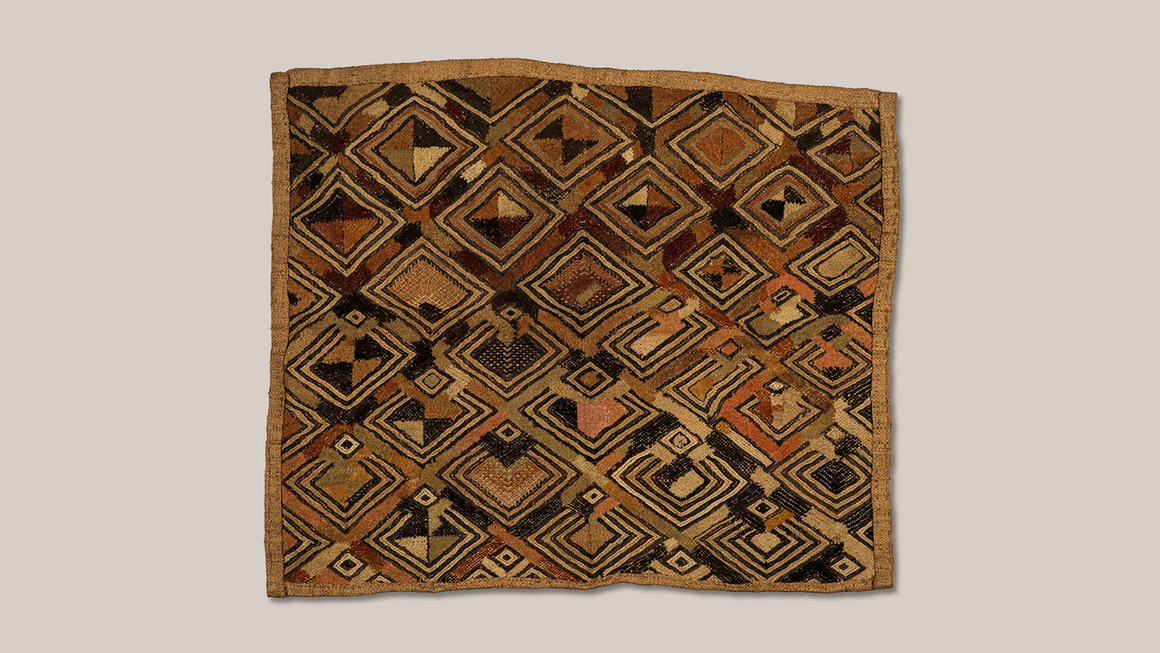
“Each motif on the fabric carries a meaning," Woto continues, in reference to the abstract beauty of layered geometries. Before being adopted into a mnemonic library of over two hundred distinct symbols, artisans’ designs were authorized by the King, with many of these motifs still known and used today. The iconic diamond shape, prevalent across most artworks, represents the Kuba people’s concept of “mbalax," which refers to the interconnectedness of all things in the universe.
Professor Woto, who is Kuba himself, is at the helm of larger coalescing efforts to safeguard Kuba artistic practices. In January of 2026, the government of the Democratic Republic of Congo declared the Kuba arts “a living national treasure." The next goal, Woto declares, is to receive UNESCO World Heritage status.
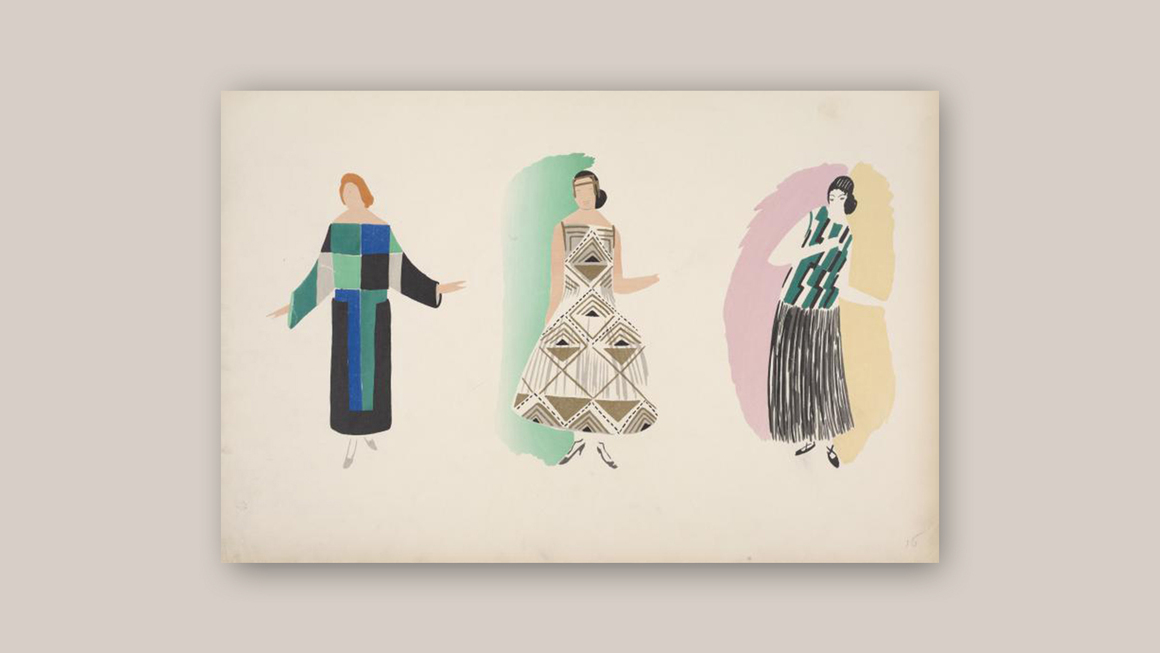
Ever since their so-called discovery by European missionaries and explorers in the late 18th century, the Kuba arts have exerted profound influence on Western artists and designers. Painters Henri Matisse and Gustav Klimt, both avid collectors of Kuba cloth, found inspiration in their abstract geometries. The avant-garde fashion and textile designs of Sonia Delaunay drew heavily from Kuba patterns. Although, any mention of her source of inspiration was never recorded.
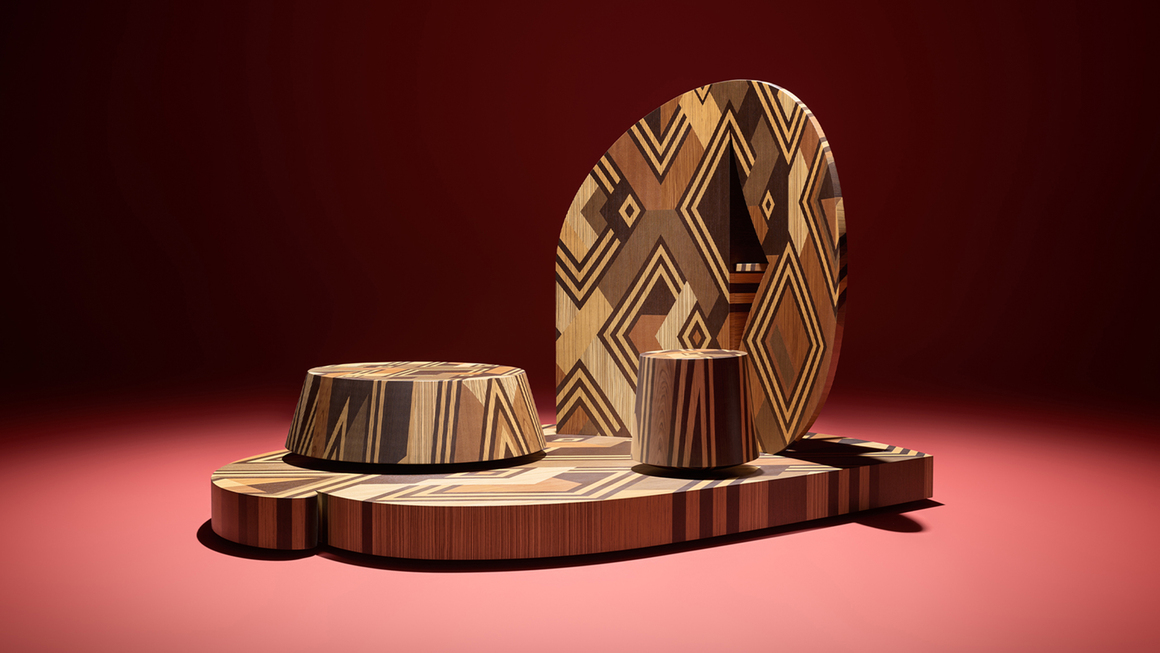
Today, Kuba’s influence is both subtle and pervasive. Many contemporary fabric houses feature Kuba-inspired textiles among their offerings, and countless designers reference Kuba motifs almost unconsciously. Our research focuses on Kuba innovation. The Lost Cloth Object, in collaboration with ALPI, for example, translates Kuba textile patterns into wood marquetry for the first time.
Despite its profound historic and contemporary impact, the assumption that Kuba is a lost or dying art form persists. Indeed, one of the few places to encounter Kuba textiles outside the Democratic Republic of Congo is in the major museums of Europe, where their categorization as pre-modern reinforces their “otherness."
The Congolese philosopher V.Y. Mudimbe offers some insight into this historical unevenness. In his seminal 1988 text, The Invention of Africa, Mudimbe takes apart the very construct of the African continent, arguing that Western systems of thought, or “gnosis," framed native subjects in the image of Europe, reshaping reality and consciousness.
These narrow limitations imposed upon Africa’s creative potential endures today, specifically in the realm of material culture. Consider this: Why is the term “handmade” perceived as luxury in Belgium, whereas in the Congolese context it is considered craft? What if the Kuba arts were valued as much as European heritage brands? Hermes (est. 1837), Cartier (est. 1847),and Prada (est. 1913) were all once suppliers to the King and the royal courts. Today, they represent small hegemonies in their respective industries worldwide.
Our final day in Kinshasa takes us to the National Museum to meet its director Henry Bundjoko. He situates Kuba’s future within a global context, explaining, “the Kuba arts cannot remain enclosed within the Kingdom when it has already traveled the world and been embraced by artists and designers elsewhere, leading to new motifs and innovations."
The recognition of Kuba craft as national living heritage is a significant stride in a greater path to reclaiming ancestral know-how. Stewards like Jess and Professor Woto play a critical role in both the transmission of knowledge and the economic empowerment of the artisans themselves.
To consider the long-term vitality of craft traditions like Kuba, we must transcend the tired epistemological frameworks of the past. Acknowledging these art forms as living is the first step, because in order for Kuba to have a future, we must understand and embrace the complexities of its present.
Malika Leiper, along with Stephen Burks, are partners in the interdisciplinary studio Stephen Burks Man Made. In June 2025, Leiper and Burks visited Kinshasa to document the Kuba arts in the short film In Search of Kuba as designers and co-curators of the exhibition Designing Dynamism: Kuba Textiles from the Democratic Republic of Congo, The Wesley Mancini Collection on view at the Mint Museum in Charlotte, North Carolina, from February 21–August 23, 2026.
Related Stories