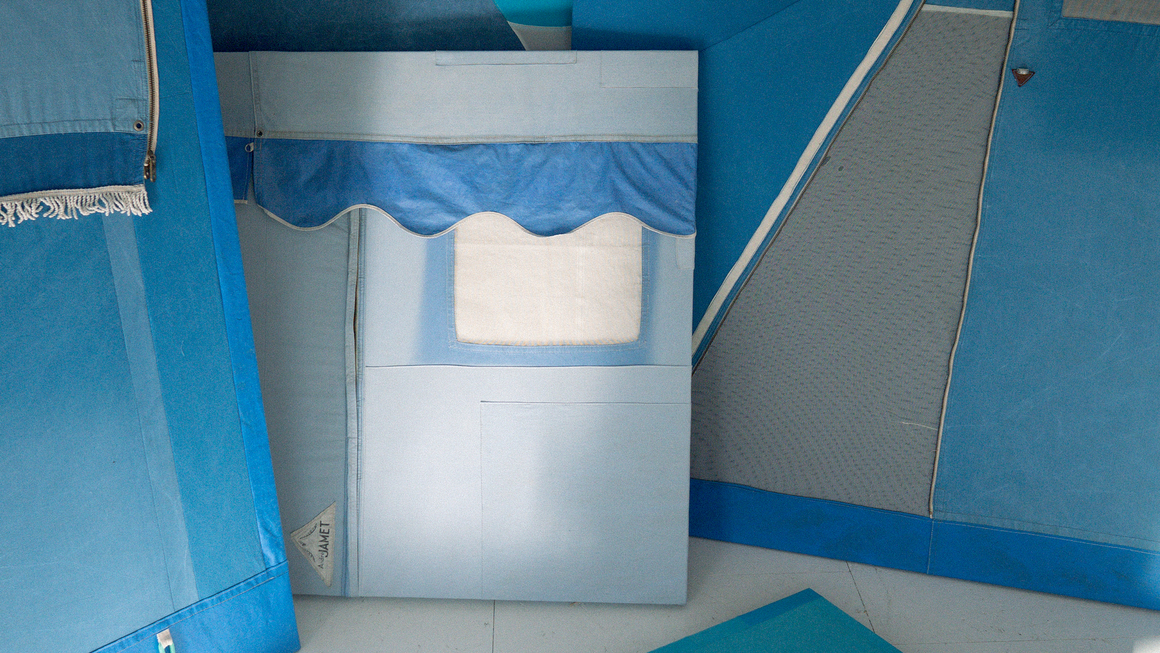
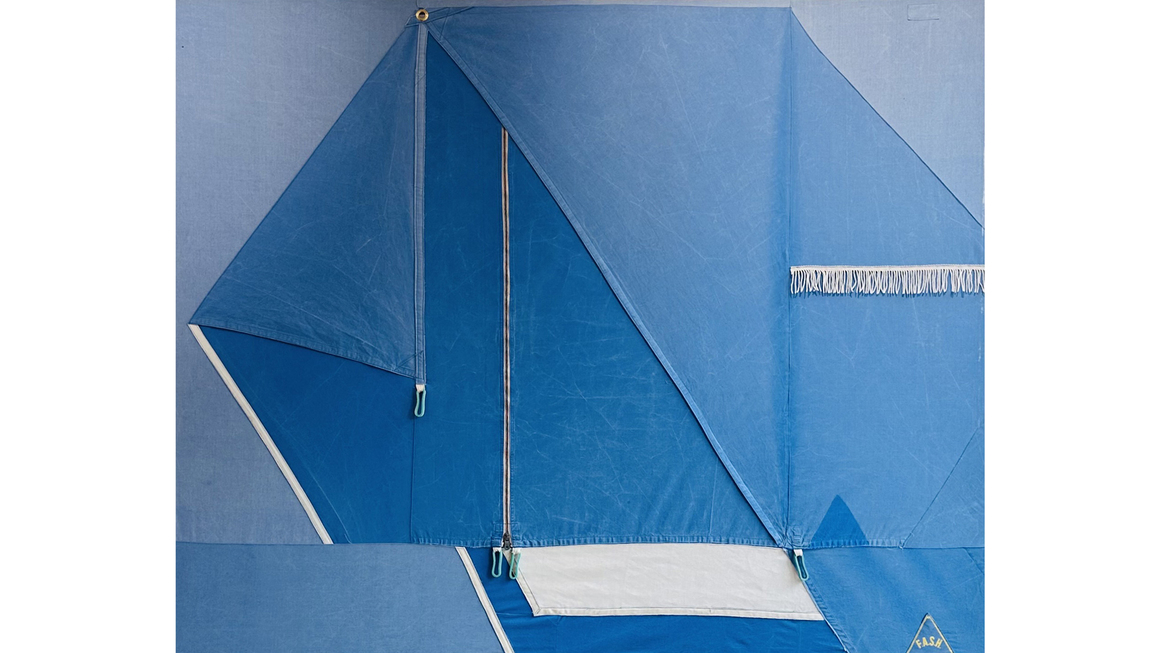
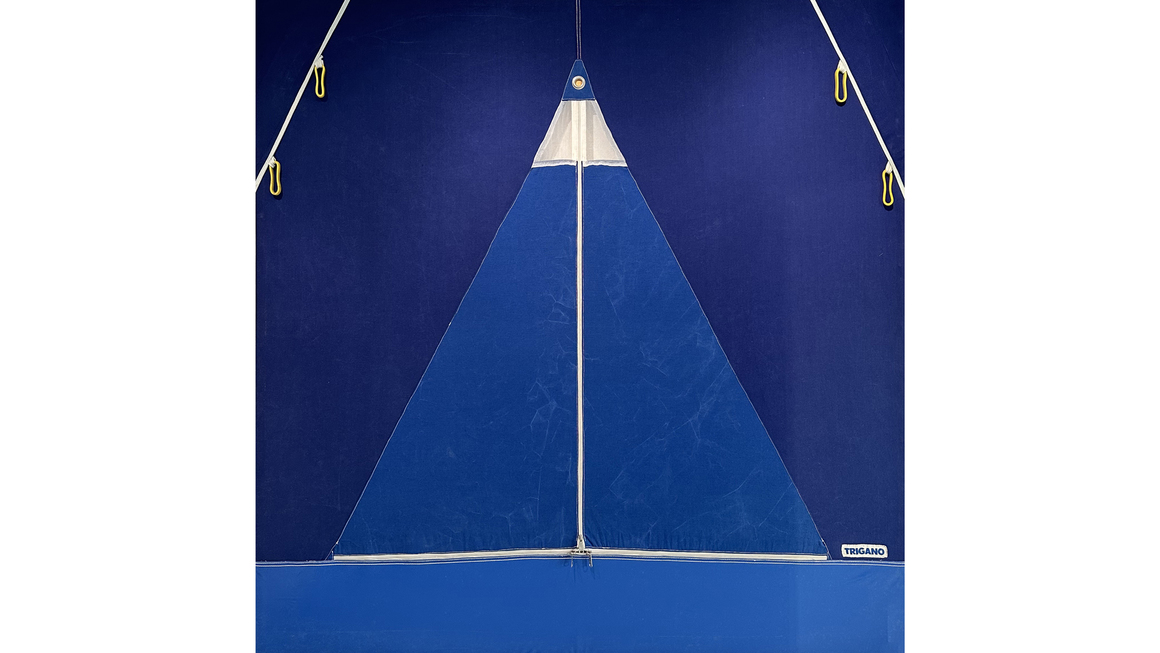
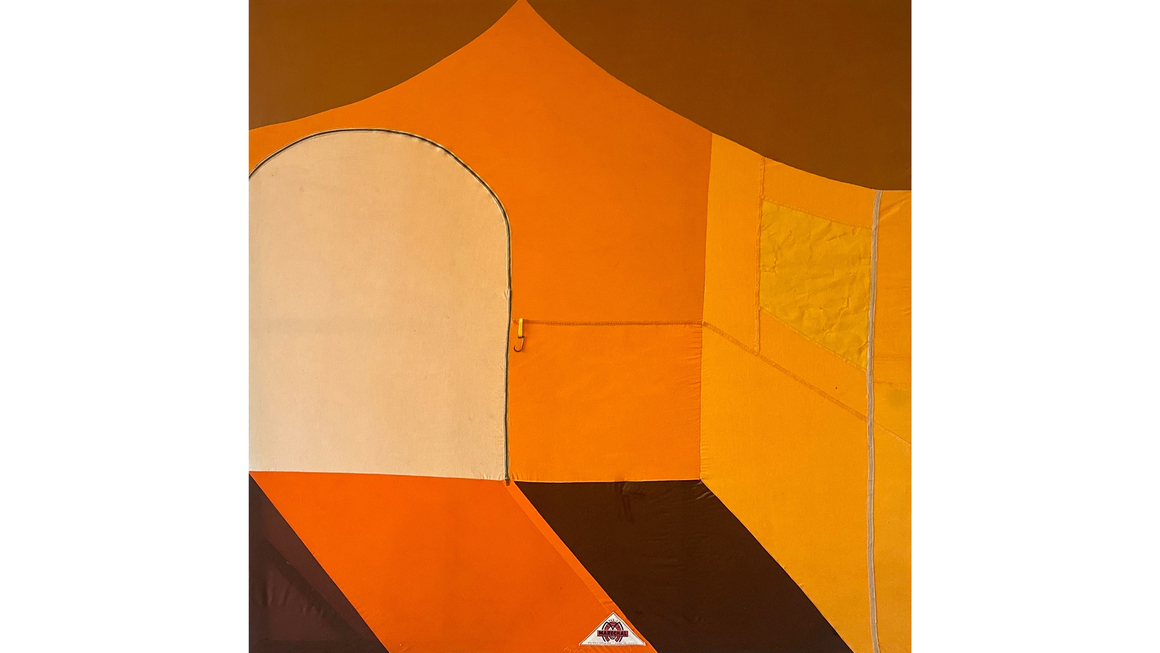
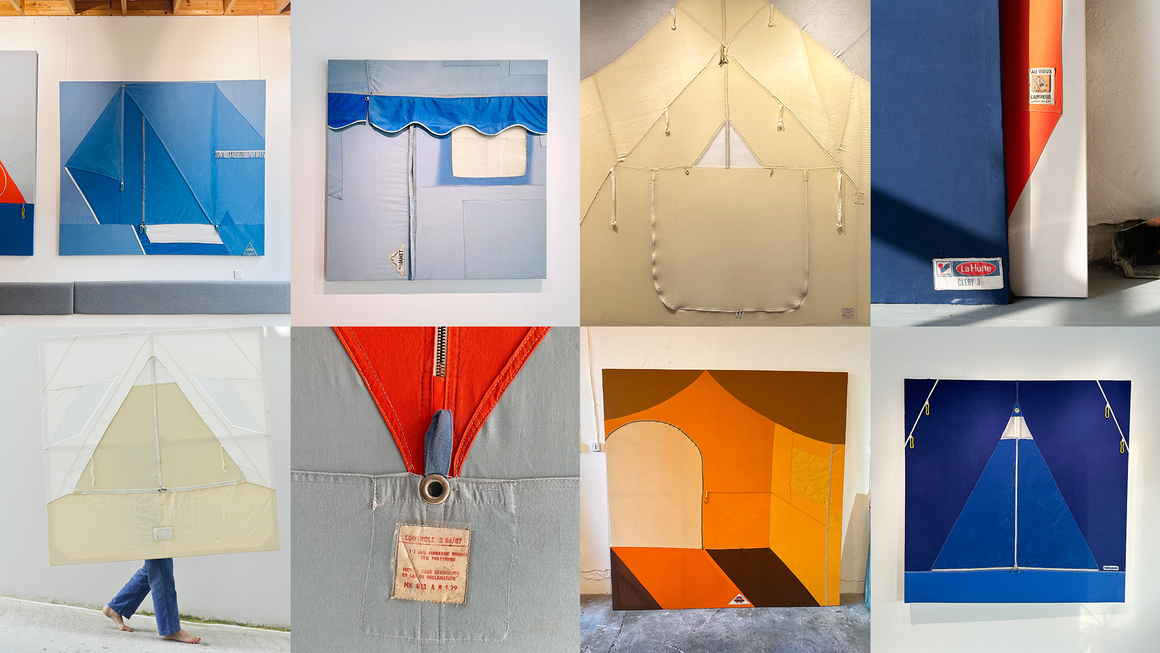
The enormous pieces on the white walls of Delphine Lamarque’s studio offer a feast for the eyes. Here, large segments of navy alternate with turquoise and cobalt, in a surface weathered by the elements. There, brown tones border oranges. Further on, soft beiges are paired with military khakis, marked by time, weathered and worn by intensive use. Seams and zippers intersect geometric planes with strict straight lines and elegant curves. Grommets, mosquito netting, and aluminum hooks lend rhythm, detail, and texture. These compositions are not paintings, although a kind of painting is indeed taking place. Not on canvas, but with canvas. Tent canvas, to be precise.
Ten years ago, Lamarque and her partner traded life in the big city for Hossegor, a small town in the southwest of France near the Bay of Biscay. Settled between the forest and the sea, her new workspace conjured childhood memories of her aunt and uncle’s beach campsite, as well as the old blue bungalow tents her parents would bring on their visits during the 1980s. After a winding career path in which working with textiles and weaving techniques and upcycling materials consistently formed a common thread, she immediately recognized the possibilities inherent to this material.
She begins by collecting old tents. After laying out, cutting apart, and washing the side walls, roof, canopy, groundsheet, and inner tent, she separates the individual elements and begins to create new compositions. She does this largely by intuition. The time-consuming process of unpicking seams, cutting fabric, assembling, pinning, and sewing resembles that of patchwork or collage. She then stretches the final result onto a wooden frame.
The first of these pieces is the “Canadienne,” featuring the iconic triangular two-pole tent from the 1970s—a tent like a child would draw. Even though, in practice, these tents were heavy and unsuitable for backpacking, Lamarque’s work undeniably evokes a sense of freedom and mobility. Carefree outdoor living under the open sky. Waking up in the morning with the sun beating down on the already sweltering tent. Feet sticking out in the dewy grass. And at night, sleeping under the stars . . . Lamarque incorporates tent labels into the compositions, with French brand names like La Cigale (“the cicada”), Cabanon (“little shed”), and Au Vieux Campeur (“at the old camper”) that further elicit camping memories and feelings.
The large, flat composites preserve the original proportions of the tent material while playing with the illusion of depth across a flat surface. Like a trompe l’oeil, the viewer feels an irresistible urge to pull the zippers to see what lies behind. In a recent collaboration with Hermès, this feature led to a new product: Behind the unzipped tent door, the viewer sees themselves in a mirror.
It is this dimension that most distinguishes Lamarque’s work. While presenting seemingly neutral planes of graphic abstraction, she consistently invites layered readings of meaning and narrative, evoking, for campers, strong memories of past journeys and sparking dreams of new treks, all through the concrete language of dismantled equipment. In the comfortable warmth of the living room or bedroom of a less adventurous person, the work may offer an intriguing, abstract landscape of planes, lines, colors, shapes, and textures onto which any thought or desire can be projected.
In her bright studio, amidst a fresh harvest of vintage tents, Lamarque herself continues to dream about new projects. While she has already begun to realize her ambitions, collaborating with major brands and exhibiting in a prominent gallery, her drive to explore remains strong. In the coming years, Lamarque envisions creating even larger works in the form of installations and sculptures, or delving into an intuitive approach, painting directly on the canvases, rather than constructing worlds within them.
Harmen Liemburg is a graphic designer, screen printer, and educator based in Wageningen, the Netherlands.
Related Stories