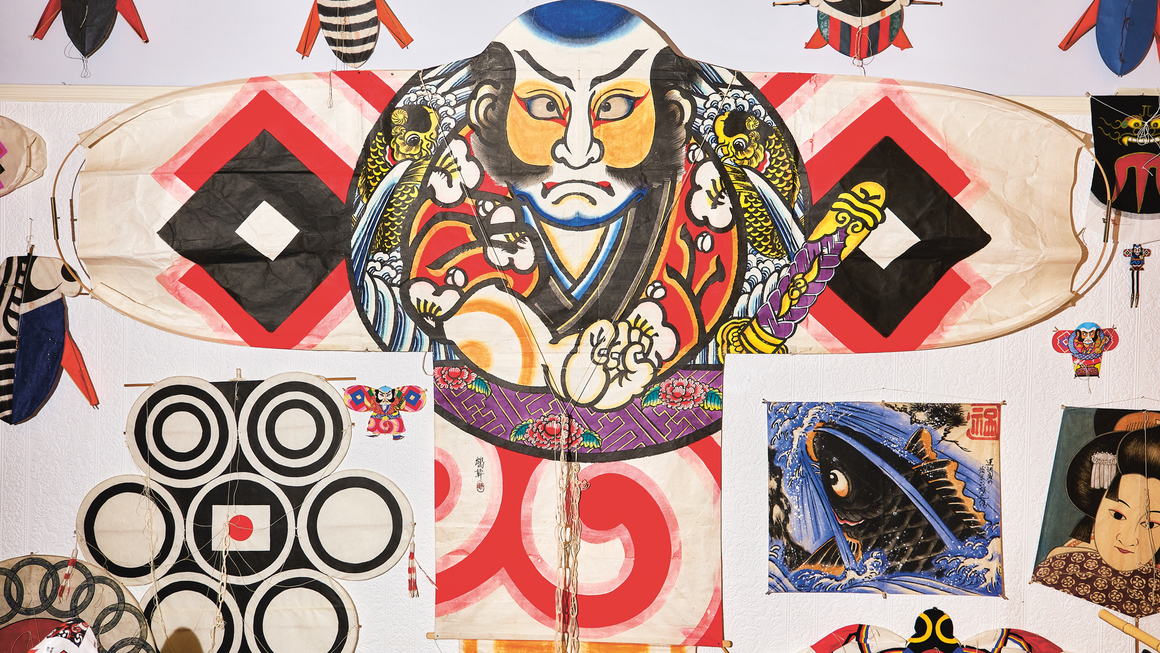
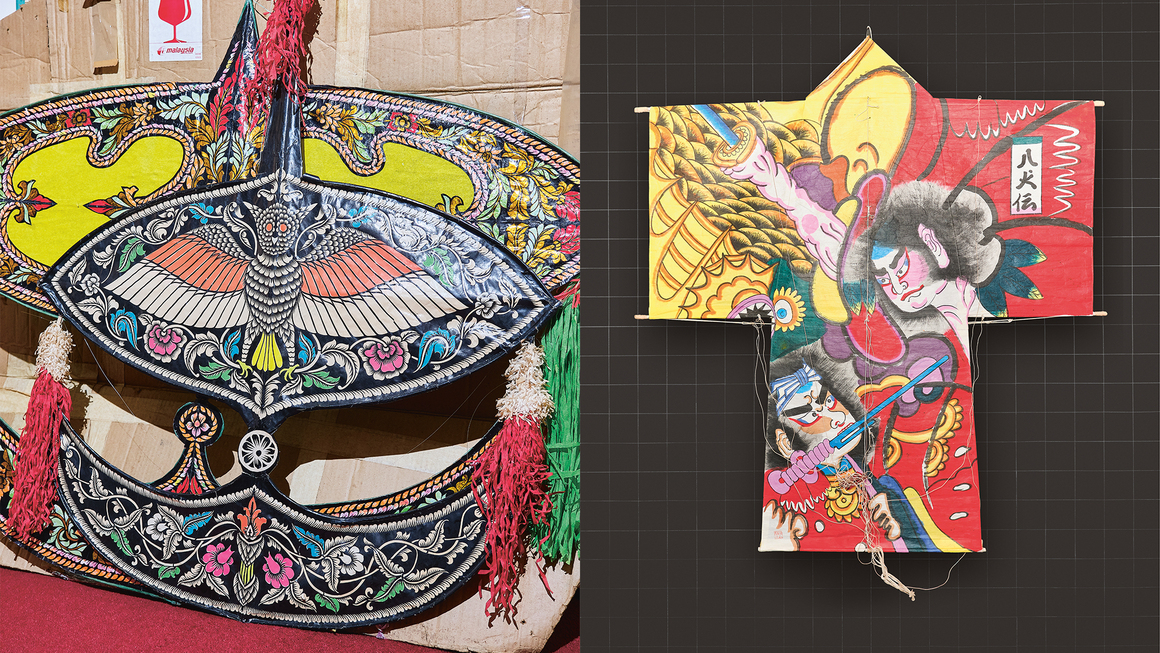
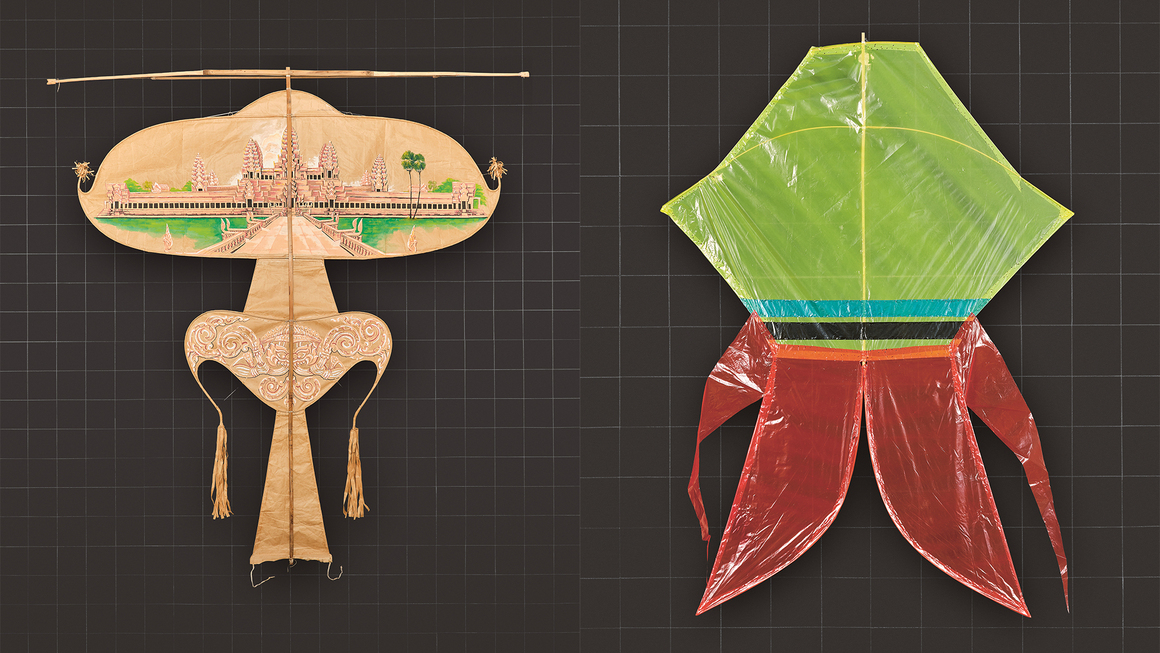
While preparing Mr. Goodman: The Kiteman, rapidly flipping through images of kites on a screen, I sometimes felt as if I were watching an animation of kite evolution. We ordered the book’s sequence with subtle variations in mind, hoping to reveal how one kite idea is adapted from, or at least connected to, another. These variations may stem from an individual maker’s style, from the materials at hand, or from the climate and cultural values of the place in which the kite was made; kites often look very different, from one region to the next.
All these differences are fascinating. Yet, as a kite flyer and builder, I am equally mesmerized by the similarities in form that help the kites to fly. Many kite designs still refer to the shape of a bird, with two large wings and a smaller wing that functions like a tail. Almost every culture has a bird kite in its repertoire. Even the English word “kite” is named after a bird of prey. This makes sense: It is natural to look to birds and butterflies when trying to design a thing that flies.
But even when kites don’t resemble flying animals, they often take a similar shape. Look at the Japanese yakko dako, the sode dako, the wau bulan from Malaysia, or the khlaeng ek from Cambodia, abstract designs from various kite cultures that embrace the same mechanical principle: A large upper wing section offers lift, paired with a smaller, lower wing section for stability. It is a remarkably effective design—look at modern aircraft.
These similarities did not come about in isolation. Principles of kite design have traveled across cultures over the course of millennia, following the flow of knowledge and trade and gradually absorbing into local traditions. Today, as the world grows smaller and kite flyers from around the globe convene ever more frequently, countless nerdy enthusiasts share knowledge in pursuit of a shared goal: making objects heavier than air fly on a string.
This text is an excerpt from Mr. Goodman: The Kiteman (2026), a book showcasing the kite collection of Malcolm Goodman, an English engineer turned kite connoisseur. The volume was designed and edited in a collaboration between Maharam and Kite Club—a collective of kite enthusiasts comprising creative director Peter Hebbing, industrial designer Bertjan Pot, and photographers Maurice Scheltens and Liesbeth Abbenes—and will be available July 2026 on maharam.com and Idea Books.
Related Stories