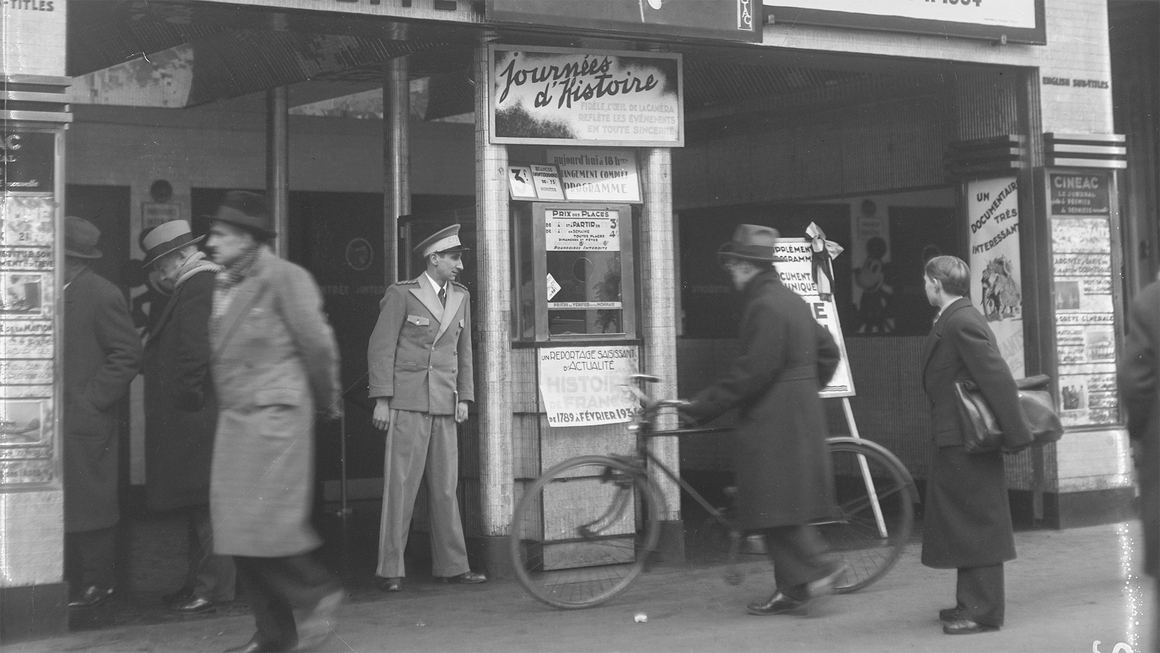
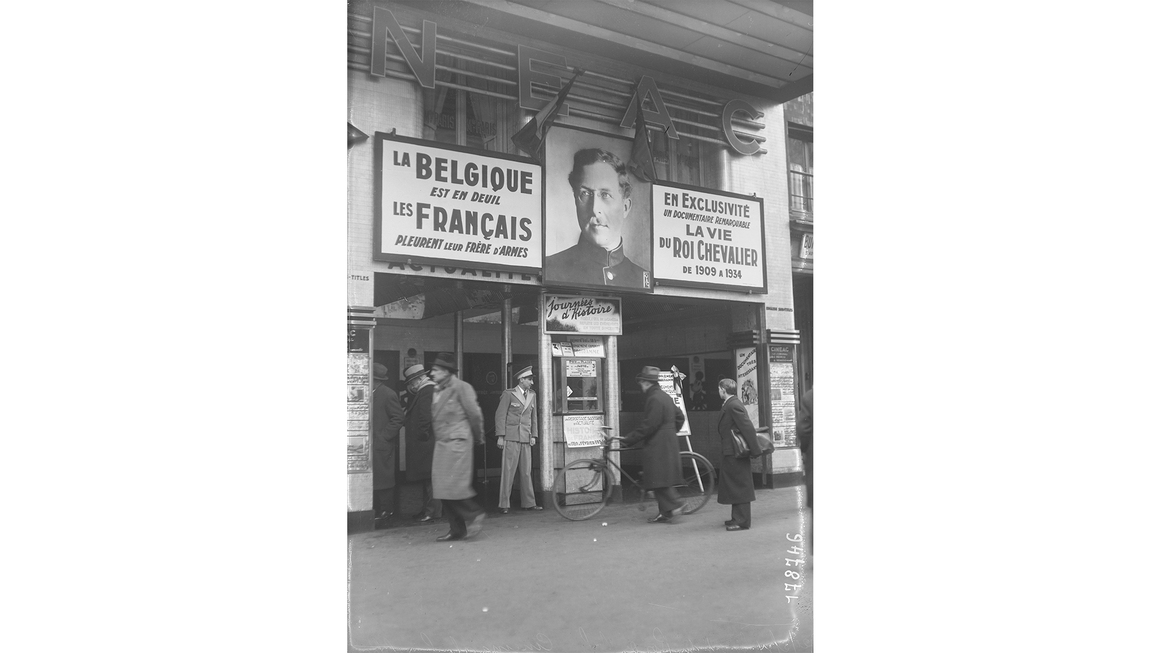
When Reginald Ford, a Welsh film buff who had forged a successful career in the French film industry during the 1920s, decided to open a new type of cinema to screen newsreels and cartoons rather than movies, he wanted its design to reflect its innovative spirit.
In 1931, he invited Polish architect Adrienne Górska to create the first of what he hoped would be a chain of Cinéacs (a combination of cinéma and actualités, the French word for “news”) on Boulevard des Italiens in Paris. Górska was at the start of her career but had won praise for her design of the interior of the home and studio of her sister, the artist Tamara de Lempicka. Yet the first Cinéac, which she designed with her future husband, the French architect Pierre de Montaut, was a triumph that marked the start of a fruitful collaboration with Ford and a thrilling experiment in cinema design.
Born in Moscow in 1899 as Adrianna Gurwik-Górska, the daughter of a wealthy Russian lawyer and Polish socialite, she had a privileged childhood, mostly in Poland, and planned to study architecture at university there. The family, including her sister, was in St. Petersburg when the Russian Revolution began. They fled to Paris in 1919, where Adrianna adopted a shorter, frenchified name, Adrienne Górska, and enrolled at architecture school to study under Robert Mallet-Stevens. One of the most influential French architects of the time, Mallet-Stevens championed an interdisciplinary approach to the arts and a vision of modernism that embraced both industrialization and craftsmanship.
As Górska tried to establish an architectural practice, De Lempicka was making her name as an artist, whose paintings of voluptuous women, some naked, others barely clad, were feted as the acme of Art Déco glamour. In 1929, De Lempicka moved into a duplex, combining an apartment and studio, in an exquisitely proportioned Art Déco building by Mallet-Stevens in Montparnasse. Górska designed the interior as a futuristic vision of glass, chrome, and steel. The praise for it helped her to win a commission to design a small apartment building in Neuilly. She was also offered a job at the firm Molinié et Nicod, where she met De Montaut. Their first joint project was Ford’s pioneering Cinéac.
Until then, cinemas were mostly converted from 19th-century music halls and theatres into luxurious “picture palaces” where people watched entire movies. Ford conceived Cinéacs as places that people slipped in and out to watch all or part of newsreels covering global events. He wanted them to exude modernity, efficiency, and convenience, attracting both a local clientele and out-of-towners who could drop in while waiting to change trains.
Górska and De Montaut designed each Cinéac with opaque facades and flashing neon lights spelling the theaters’ names. The foyers were equally enticing, notably by showing off the state-of-the-art lighting, projection, and sound systems. Ford was so pleased that he commissioned more Cinéacs from them and encouraged them to experiment, notably by encasing the gleaming projection area of Cinéac Montparnasse in glass.
The project offered the type of commission that architects long for but rarely achieve: the opportunity to define the design of a new type of building. In 1937, Górska was formally recognized by her homeland with an invitation to design the Polish Pavilion at the International Exhibition of Art and Technology in Modern Life in Paris, working alongside such architectural grandees as Alvar Aalto and Le Corbusier.
But she and De Montaut lost their visionary client that year when Ford died at the age of 48. They completed other Cinéacs and travelled to Poland in 1939 to design newsreel cinemas there for Pathé Nathan, only to return to France after Germany invaded. Little is known of Górska’s life and work from then onwards, except that she and De Montaut restored several decrepit, often war-damaged theatres into cinemas. Some were impressive, notably the Palmarium, a bombed-out music hall in Tunis which they transformed it into a cinema, tearoom, and nightclub. At some point, they left Paris for the South of France, where Górska died in the coastal town of Beaulieu-sur-Mer in 1969, followed five years later by De Montaut’s death in Paris.
Alice Rawsthorn is a London-based writer on design. Her books include Hello World: Where Design Meets Life published by Hamish Hamilton, Design as an Attitude published by JRP|Ringier, and, most recently, Design Emergency: Building a Better Future, co-written with Paola Antonelli and published by Phaidon. She and Antonelli are co-founders of the Design Emergency podcast.